Explanation
We want to find the derivative of:
\(y = x^x\)
where:
\(x>0\)
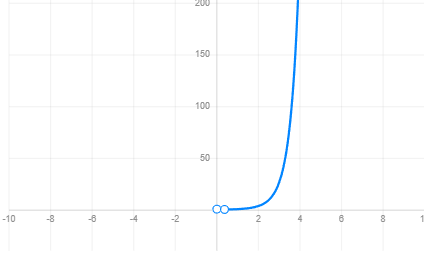
This function is special because:
- the base is
- and the exponent is also
So it is not:
- a normal power function like
- or a normal exponential function like
Because of this, the usual differentiation rules cannot be applied directly.
In this lesson, we solve the derivative of in two ways:
- Using exponential and logarithm properties
- Using logarithmic differentiation
Formula / Rule
Logarithm Property
Derivative of
Example
Method 1 — Rewrite Using Exponentials
Rewrite:
\(x^x=e^{ln(x^x)}\)
Use the logarithm property:
\(x^x=e^{x ln(x)}\)
Differentiate:
\( \frac{d}{dx}(x^x)=\frac{d}{dx} (e^{x ln(x)}) \)
Using the chain rule:
\( \frac{d}{dx}(x^x) =e^{xln(x)} \frac{d}{dx} (xln(x)) \)
Using the product rule:
\( \frac{d}{dx} (xln(x))=ln(x)+1 \)
So:
\( \frac{d}{dx}(x^x) = e^{x ln(x)} (ln(x)+1) \)
Since:
\( e^{x ln(x)} = e^{ ln(x^x)} = x^x\)
So:
\( \frac{d}{dx}(x^x) = x^x (ln(x)+1) \)
Method 2 — Logarithmic Differentiation
Let:
\(y=x^x\)
Take natural logarithm for both sides:
\( ln(y)=ln(x^x) \)
Using the logarithm property:
\( ln(y)=xln(x) \)
Differentiate implicitly:
\( \frac{y′}{y} =ln(x)+1 \)
Multiply both sides by \(y\):
\( y′=y(ln(x)+1) \)
Substitute:
\( y=x^x \)
So:
\( y′=x^x (ln(x)+1) \)
Both methods give the same answer.