Explanation
The algebra identity
\(a^2 – b^2 = (a+b)(a-b)\)
is called the difference of two squares identity.
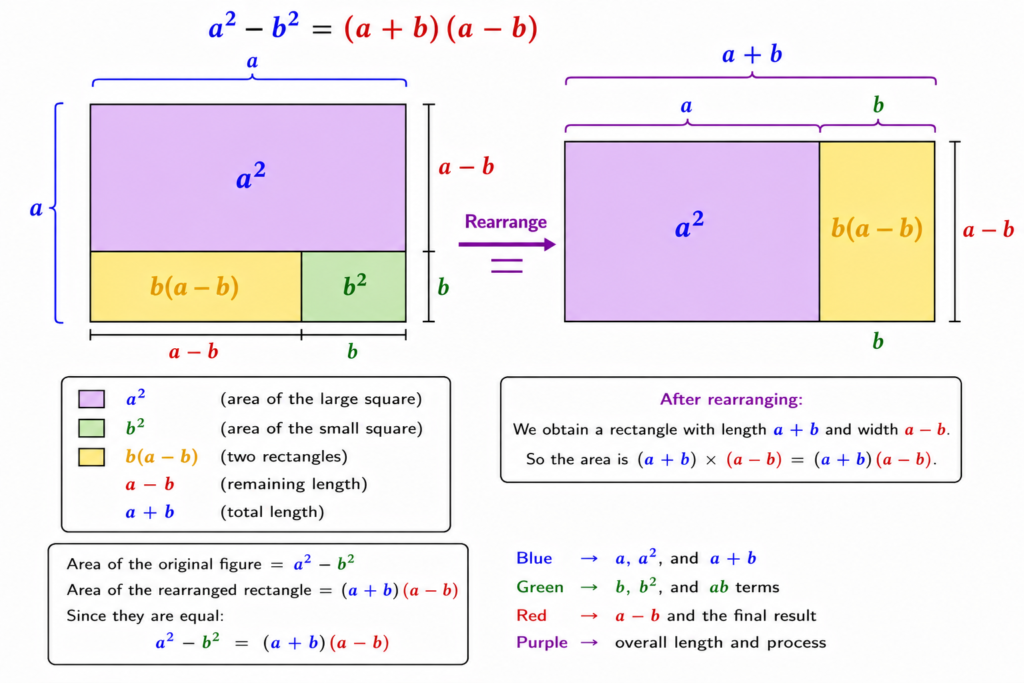
In this lesson, we explain this identity geometrically using areas.
We begin with:
- a large square with side length \(a\)
- a smaller square with side length \(b\) inside it
The area of the large square is:
\(a^2\)
The area of the small square is:
\(b^2\)
So the shaded remaining area is:
\(a^2−b^2\)
Now we rearrange the remaining shape by rotating one rectangular part.
After rearranging, the irregular shape becomes a rectangle.
The dimensions of the rectangle are:
- length \(a+b\)
- width \(a−b\)
So the area of the rectangle is:
\((a+b)(a−b)\)
Since both shapes represent the same area:
\(a^2−b^2=(a+b)(a−b)\)
This proves the identity geometrically.
Formula / Rule
Area of a Rectangle
Area \(=\) length \(\times\) width
Area of a Square
Area \(=\) side \(\times\) side
Difference of Two Squares Identity
\(a^2 – b^2 = (a+b)(a-b)\)
Example
Suppose:
\(a=7,b=3\)
Using the identity:
\(a^2−b^2=(a+b)(a−b)\)
Left side:
\(7^2−3^2=49−9=40\)
Right side:
\((7+3)(7−3)=(10)(4)=40\)
Both sides are equal.
So:
\(7^2−3^2=(7+3)(7−3)\)
Video Explanation
Practice
Continue Learning
- \((a – b)^2\) – Geometric Derivation
- \((a + b)^2\) – Geometric Derivation
- \(a^2 – b^2\) – Geometric Derivation (Current lesson)
- \(a^2 – b^2\) – Algebraic Proof