Explanation
The algebra identity
\((a+b)^2=a^2+2ab+b^2\)
is one of the most common identities in algebra.
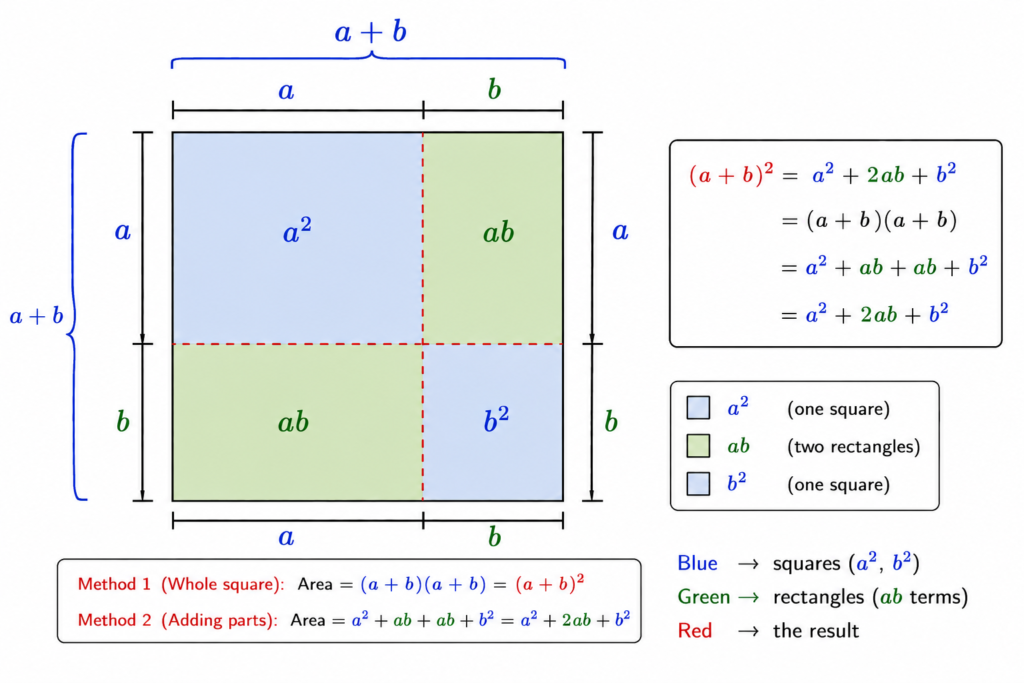
In this lesson, we explain this identity geometrically using areas.
We begin with a square whose side length is:
\(a+b\)
Since the shape is a square, all sides have length:
\(a+b\)
We divide the square into four smaller regions:
- one square with area \(a^2\)
- two rectangles, each with area ab
- one square with area \(b^2\)
The total area of the large square can be found in two ways.
Method 1 — Using the Whole Square
The side length is:
\(a+b\)
So the area is:
\((a+b)^2\)
Method 2 — Adding the Smaller Areas
Add the four regions:
\(a^2+ab+ab+b^2\)
Simplify:
\(a^2+2ab+b^2\)
Since both methods calculate the same area:
\((a+b)^2=a^2+2ab+b^2\)
This proves the identity geometrically.
Formula / Rule
Area of a Rectangle
Area \(=\) length \(\times\) width
Area of a Square
Area \(=\) side \(\times\) side
Algebra Identity
\((a+b)^2=a^2+2ab+b^2\)
Example
Suppose:
\(a=4,b=3\)
Using the identity:
\((a+b)^2=a^2+2ab+b^2\)
Substitute the values:
\((4+3)^2=4^2+2(4)(3)+3^2\)
Simplify:
\(7^2=16+24+9\)
\(49=49\)
Both sides are equal, so the identity is correct.
Video Explanation
Practice
Continue Learning
- \((a – b)^2\) – Geometric Derivation
- \((a + b)^2\) – Geometric Derivation (Current lesson)
- \(a^2 – b^2\) – Geometric Derivation
- \(a^2 – b^2\) – Algebraic Proof